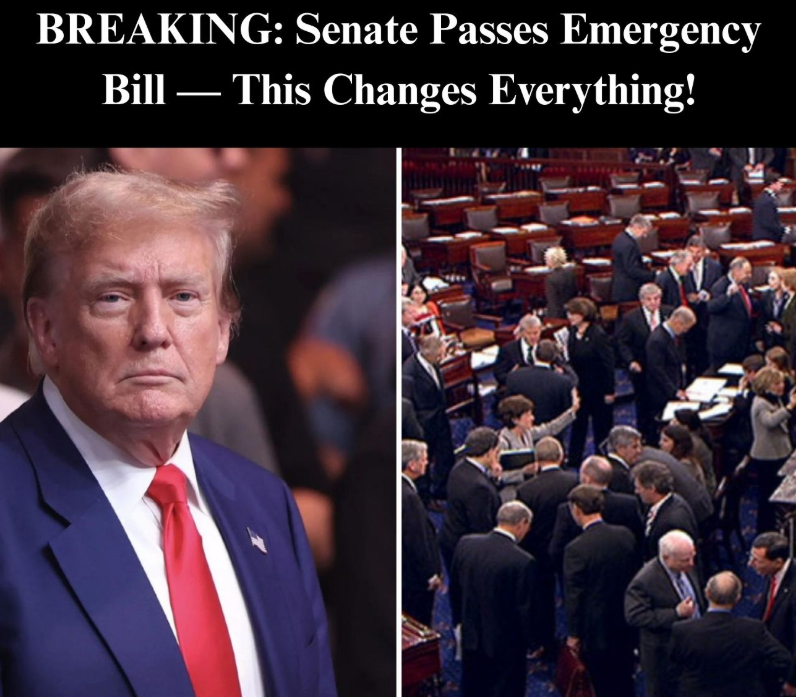

The Republican-controlled U.S. Senate passed a three-bill spending package on Thursday afternoon, clearing its last procedural hurdle and setting up a final vote later in the day.
Lawmakers are racing against the clock to avoid a partial government shutdown after just emerging from the longest closure in history a few months ago. They have until January 30 to do so.
The first vote on Thursday was a big test of whether the two sides could work together or if they would be split by politics again, like they were in September. The overwhelmingly bipartisan vote showed that Senate Republicans and Democrats have agreed to stop fighting over government funding for now.
The House passed the $174 billion package last week. It includes bills to fund agencies that deal with commerce, justice, science, and related fields; energy and water development and related fields; and the interior, environment, and related fields.
If it passes later on Thursday, it will be the sixth spending bill that lawmakers have sent to President Donald Trump.
But it’s only halfway to the twelve that are needed to keep the government running. Many lawmakers agree that a short-term funding extension, called a continuing resolution (CR), will be needed to keep the government running and avoid a shutdown.
This is because there isn’t much time left before the deadline, and there are still problems with the Department of Homeland Security (DHS) funding bill.
John Thune, the Republican leader in the Senate, was hopeful that the House would pass more funding bills that would help with the DHS problem. But he didn’t rule out the idea that lawmakers might have to use a CR just for that agency as political divisions grow.
“That will be the hardest one for sure,” Thune said. “And I can’t predict what happens, but I think you have to, you know, reserve some optionality.”
After an ICE agent shot and killed Renee Nicole Good, congressional Democrats have put their foot down on the DHS funding bill. They want limits on what ICE agents can do.
But it’s not likely that Republicans will agree to that request, so the bill will stay in limbo for now. That gap won’t be easy to cross, and the Senate is getting ready to leave for a week. They will come back to Washington, D.C., the week of the funding deadline.
Senate Democrats also don’t want to go with a year-long CR. This is a good sign that Senate Minority Leader Chuck Schumer, D-N.Y., and his group are serious about getting the government funded.
Earlier this week, Schumer praised the Democratic negotiators who worked on the package and said that it was full of their own spending priorities meant to fight Trump.
“Their leadership stopped the worst of Donald Trump’s devastating cuts and protected investments that millions of Americans depend on, from education to housing to jobs,” Schumer said. “Though this isn’t the finish line, it’s a good step in the right direction.”
This Senate has been busy this week.
The Senate on Tuesday voted to block a resolution that would have required President Donald Trump to seek congressional approval before taking further military action against Venezuela.
The measure, introduced by Sen. Tim Kaine, D-Va., was defeated on a 51-50 vote, with Vice President JD Vance casting the tie-breaking vote.
The resolution had sought to invoke the War Powers Act following recent U.S. military operations involving Venezuela.
Supporters of the resolution said Congress must reassert its constitutional authority over decisions to use military force, arguing the administration acted without sufficient consultation with lawmakers.
Kaine said the vote underscored what he described as a growing imbalance of power between the executive and legislative branches.
Republicans opposing the measure said it was unnecessary, arguing the United States is not engaged in sustained hostilities that would trigger the War Powers Act.
Senate GOP leaders said the administration has provided assurances that there are no ongoing plans for expanded military action or deployment of U.S. ground forces.
The vote came after two Republican senators — Josh Hawley of Missouri and Todd Young of Indiana — who had initially supported advancing the resolution, reversed course after getting personal assurances from Secretary of State and former Florida Sen. Marco Rubio that there would be no U.S. ground operations in the country.
Their reversal allowed Republicans to maintain control of the chamber’s agenda.