In a political environment defined by constant controversy and media spectacle, few names provoke as immediate and visceral a reaction as Jeffrey Epstein. His crimes, the network of powerful individuals surrounding him, and the institutional failures that allowed his activities to continue for years remain a deep stain on public trust in American institutions.
Because of that gravity, any release of information tied to Epstein carries an enormous responsibility. Documents, photographs, and testimony connected to the case are not simply political ammunition—they are part of a painful history involving victims who continue to seek justice.
Recently, however, Senator Marco Rubio has accused Democrats on the House Oversight Committee of mishandling that responsibility. According to Rubio, what was presented as a push for transparency surrounding Epstein-related materials has instead become a political performance—one that relies on selective presentation and suggestion rather than clear evidence.
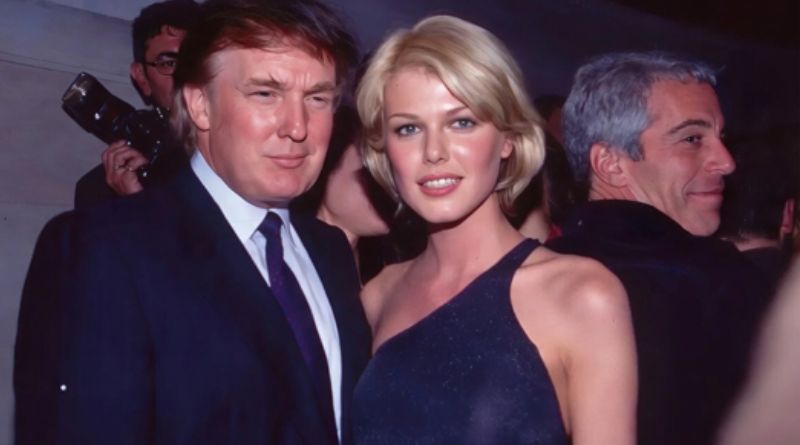
The controversy began after images circulated that appeared to show former President Donald Trump in the company of Epstein. In versions initially shared by Democratic lawmakers and commentators, parts of the photographs were obscured, with certain faces blurred or masked. The images quickly spread online, fueling speculation about the identities of the people present and the nature of the gathering.
Rubio argues that the way those images were released created a misleading narrative.
When unedited versions of the photos later surfaced, he said, they told a far less dramatic story than the one implied by the earlier, partially concealed images. According to Rubio, the photographs show Trump standing in a public setting with an adult model, not in a private or suspicious environment.
In his view, there is nothing in the images that suggests illegal activity, coercion, or any connection to the crimes for which Epstein became notorious.
“This is not transparency,” Rubio said in response to the controversy. “This is Democratic manipulation.”
Rubio’s criticism touches on a broader concern about how Epstein-related materials are being presented to the public. The senator argues that selective releases—particularly when they involve visual media—can create powerful impressions that may not reflect the underlying facts.
Photographs, after all, carry enormous emotional weight in politics. A single image can suggest relationships, intent, or wrongdoing even when those implications are not supported by evidence. When context is missing or details are hidden, viewers often fill in the gaps themselves.
Rubio contends that the decision to release masked images rather than the full, unedited photographs encouraged precisely that kind of speculation. By partially obscuring some individuals while highlighting others, he argues, the images invited people to draw conclusions without having the full picture.
He described the tactic as “trial by insinuation,” warning that it risks turning congressional oversight into a tool for political messaging rather than a search for truth.
According to Rubio, once the unmasked photos appeared, the controversy lost much of its initial force. What had seemed suggestive in the edited versions appeared routine in the originals—simply a public social setting involving adults.
“If there were evidence of wrongdoing,” Rubio said, “they wouldn’t need to rely on blurred faces or selective framing. The facts would speak for themselves.”
Importantly, Rubio has emphasized that his criticism is not meant to diminish the seriousness of Epstein’s crimes. The financier’s abuse of underage girls and the legal failures that allowed him to evade accountability for years remain deeply disturbing. Rubio acknowledged that Epstein’s victims deserve justice and that legitimate investigations into anyone connected to his activities should continue.
His objection, he says, lies in what he sees as the political use of Epstein’s name and files to cast suspicion without concrete proof.
In Rubio’s view, congressional oversight should be guided by clear evidence—documents, sworn testimony, and verifiable facts—not by suggestive imagery or partial disclosures designed to generate headlines.
“Using Epstein’s name to plant doubt without real evidence isn’t investigation,” Rubio said. “It’s a smear.”
This dispute also raises a broader question about the standards used when evaluating associations with Epstein. Like many wealthy or prominent figures in the 1990s and early 2000s, Trump encountered Epstein in social settings before the full scope of Epstein’s criminal behavior became widely known.
Photographs from that era have circulated for years and often reappear during moments of political tension.
Rubio argues that such images, on their own, do not prove misconduct. In the photos at the center of this latest controversy, he notes, there is no depiction of illegal behavior, underage individuals, or private circumstances that would suggest wrongdoing.
If proximity alone were treated as proof, Rubio suggests, many public figures who moved in similar social circles during that time could be implicated without justification.
For him, the issue is ultimately about standards of proof. Oversight committees possess significant authority precisely because they are expected to operate above partisan battles. When investigations appear to rely on implication rather than evidence, Rubio argues, public confidence in those institutions erodes.
The episode also highlights the role of media amplification. The masked images spread rapidly across social media and news platforms, often accompanied by commentary implying scandal or hidden connections. When the unedited photographs emerged, Rubio said, the corrections and clarifications received far less attention.
This pattern—where initial speculation travels farther than later clarification—can reinforce misleading impressions long after the facts become clearer.
“Once a narrative takes hold,” Rubio said, “the truth has to work twice as hard to catch up.”
At a deeper level, the dispute reflects the fragile state of public trust in American political institutions. Polls consistently show that confidence in Congress remains low, and episodes like this can reinforce perceptions that investigations are driven by political motives.
Rubio argues that genuine transparency requires full disclosure: complete documents, unedited materials, sworn testimony, and conclusions grounded in evidence rather than speculation.
Anything less, he warns, risks turning oversight into theater.
Ultimately, the debate over the Epstein photos is not just about one set of images or one political figure. It is about how democratic institutions handle highly sensitive material connected to serious crimes.
Epstein’s case demands careful, responsible treatment. For Rubio, that means avoiding selective presentation and focusing instead on verifiable facts.
“When transparency requires concealment,” he said, “the real question isn’t about the people in the photo—it’s about the people releasing it.”
In an era already saturated with suspicion and polarization, the way such information is handled may shape not only individual reputations, but also the credibility of Congress itself.