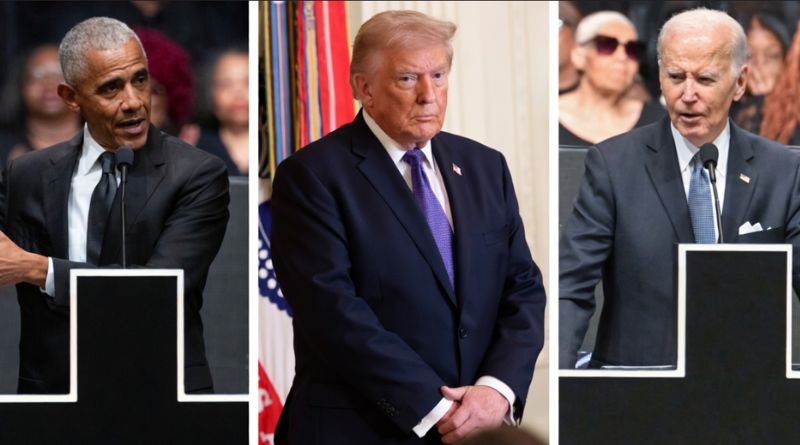
The funeral of longtime civil rights leader Jesse Jackson brought together prominent political figures from across the United States on Friday, including former Presidents Joe Biden, Barack Obama, and Bill Clinton. Also in attendance were former Vice President Kamala Harris, former Secretary of State Hillary Clinton, and First Lady Jill Biden. However, the gathering—intended to honor Jackson’s decades-long legacy—quickly drew controversy after several speakers made remarks referencing President Donald Trump and current political tensions.
During her remarks, Harris reflected on current political developments and suggested that many of the events unfolding today were anticipated by leaders and activists in previous years. At one point in her speech, she remarked that she had predicted much of what the country is experiencing now, adding that while she did not want to say “I told you so,” many people had seen it coming. Observers noted that Harris delivered part of her message using a tone and cadence that appeared intended to resonate with the audience.
Obama also referenced the current political climate during his own speech. While focusing largely on Jackson’s contributions to civil rights and social justice, he alluded to the challenges facing the country today and emphasized the importance of protecting democratic values and civil liberties—issues that have frequently been part of his public commentary in recent years.
The remarks by Harris and Obama were met with criticism from Jesse Jackson Jr., the son of the late civil rights leader. Jackson Jr., who previously served as a Democratic congressman from Illinois, publicly expressed concern that political commentary was overshadowing the intended purpose of the memorial service.
In a statement addressing attendees and observers, Jackson Jr. urged those participating in the services to keep the focus on his father’s life and legacy rather than partisan disagreements. He emphasized that the memorial was meant to be a space for people from all political backgrounds to come together in respect and gratitude.
According to Jackson Jr., his father’s work throughout his life transcended traditional political divides. He pointed out that the elder Jackson built relationships across ideological lines and believed in bringing Americans together regardless of party affiliation or political philosophy. For that reason, he asked guests and speakers to approach the services with a spirit of unity and appreciation.
Jackson Jr. stated that the memorial events were open to everyone—Democrats, Republicans, liberals, conservatives, and those across the political spectrum. He said his father’s legacy was broad enough to encompass all Americans and urged those participating to honor that spirit.
While several prominent political figures attended the service, one notable absence was Michelle Obama, who was not present at the ceremony.
The controversy surrounding the funeral remarks coincided with renewed debate in Washington over presidential war powers and the role of Congress in authorizing military action. The discussion was fueled in part by a resurfaced video clip of former House Speaker Nancy Pelosi addressing military operations conducted during the Obama administration.
The clip, recorded during a press event in 2011, shows Pelosi responding to questions about military action in Libya ordered by President Obama. During the exchange, a reporter asked whether Obama needed congressional authorization to initiate the operation. Pelosi replied that the president did not require such authorization at that stage of the mission.
At the time, the United States and its allies were launching airstrikes as part of a military intervention aimed at preventing forces loyal to Libyan leader Muammar Gaddafi from attacking civilian protesters during the country’s uprising. The campaign was known as Operation Odyssey Dawn and involved cooperation between U.S. forces and NATO allies.
The resurfaced video has gained attention because Pelosi recently criticized President Trump’s decision to authorize military strikes targeting Iran. In a public statement posted online, she argued that initiating military hostilities without prior approval from Congress could violate constitutional limits on presidential authority.
Pelosi wrote that decisions leading the nation into war should be authorized by Congress, referencing the War Powers Resolution, which was passed in the aftermath of the Vietnam War. The resolution was designed to ensure that both the executive and legislative branches share responsibility for decisions involving military conflict.
Supporters of Trump have pointed to Pelosi’s earlier comments about Libya as evidence of an inconsistency in her position. Critics argue that her previous remarks suggested a more flexible interpretation of presidential authority than the stance she has taken in response to the recent Iran operation.
Pelosi’s office has responded by emphasizing that the circumstances surrounding the two situations are fundamentally different. Her spokesperson, Ian Krager, stated that the military operation in Libya was limited in scope, whereas the potential for a broader and prolonged conflict with Iran raises significantly greater concerns.
According to the spokesperson, Pelosi has maintained a consistent position that when military action risks expanding into sustained warfare, Congress should play a direct role in authorizing it under the Constitution and the War Powers Resolution.
The recent strikes against Iran were authorized by President Trump as part of a joint military operation between the United States and Israel. The strikes targeted Iranian military leadership and strategic infrastructure, with administration officials describing the action as a preventive measure intended to stop Iran from advancing toward nuclear weapons capability.
U.S. officials said the operation eliminated several high-ranking Iranian figures, including Supreme Leader Ali Khamenei, though details about the broader consequences of the strike remain closely monitored by international observers.
In response to the escalation, Pelosi and other Democratic lawmakers have pushed for a War Powers resolution aimed at limiting further U.S. military action against Iran without explicit authorization from Congress. However, attempts to advance the measure have so far failed to gain enough support to move forward.
Debate over presidential authority in military matters is not new. Both Republican and Democratic administrations have historically argued that the War Powers Resolution places unconstitutional restrictions on the president’s authority as commander-in-chief. As a result, presidents from both parties have sometimes authorized military operations without a formal declaration of war from Congress.
The renewed discussion surrounding these issues highlights the continuing tension between the executive and legislative branches over how and when the United States should engage in military conflict—a debate that has persisted for decades and remains unresolved in modern American politics.