
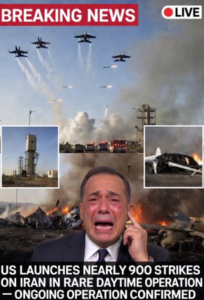
Witnesses across several regions reported seeing long white contrails cutting across the daytime sky as missiles and aircraft moved toward their targets. Explosions were heard near multiple military facilities, while air defense systems were reportedly activated in an attempt to intercept incoming projectiles.
If confirmed, the operation could rank among the largest coordinated strike campaigns in the region in decades—an event that may reshape the strategic balance in the Middle East.
A Rare Daytime Operation
Modern military strategy typically favors operations conducted under the cover of darkness. Night missions provide natural concealment for aircraft and special operations units, making it harder for defenders to detect and track incoming threats. Darkness also reduces the likelihood of visual detection by civilians and surveillance systems.
The reported strikes, however, appear to have broken from that pattern.
Launching such a large-scale attack during daylight hours can carry significant symbolic meaning. Military analysts note that daytime operations sometimes signal a high level of confidence in air superiority and operational control.
In simple terms, conducting strikes in full daylight can send a message that the attacking force does not fear interception or effective resistance.
Targets Across Key Military Infrastructure
Early reports suggest the operation targeted several types of strategic military infrastructure across different parts of Iran.
Facilities believed to have been struck include missile storage depots, radar and early-warning installations, air defense batteries, command and communication centers, Revolutionary Guard–linked military bases, and logistics hubs used for transporting weapons.
Analysts say the goal may have been to disrupt Iran’s ability to coordinate missile launches and organize defensive responses.
If radar systems and communication networks are damaged or disabled, a military’s capacity to track incoming aircraft and respond quickly can be severely limited. In military terminology, this approach is sometimes described as “blinding the battlefield.”
Why Radar and Missile Systems Matter
In modern warfare, radar networks and missile infrastructure form the backbone of a nation’s defensive capability.
Radar installations allow countries to detect aircraft or missiles from long distances. Once a threat is identified, air defense units can launch interceptor missiles to destroy incoming weapons before they reach their targets.
By targeting radar hubs early in an operation, an attacking force can significantly weaken a defender’s ability to react.
Missile depots are also high-value targets. Destroying stored missiles reduces the likelihood of retaliatory strikes later in a conflict.
Contrails Over the Horizon
One of the most striking images associated with the reported operation involves the numerous contrails visible in the sky.
Contrails—thin white trails left by aircraft or missiles at high altitudes—form when hot exhaust gases mix with extremely cold air in the upper atmosphere.
When large numbers of aircraft or missiles pass through the sky in a short time, these trails can create a web-like pattern stretching across the horizon.
Residents in several areas reportedly shared photos and videos showing these white streaks crossing the sky in broad daylight, a visual that can have a powerful psychological effect on those witnessing it.
Air Defense Systems Respond
Iran’s air defense network reportedly reacted quickly once the strikes began. Sirens and alert systems were activated in several areas, and defensive missile launches were reported as units attempted to intercept incoming weapons.
Air defense systems work by detecting incoming projectiles and launching interceptor missiles designed to destroy them before impact.
However, defending against a large, coordinated wave of attacks can be extremely difficult. When missiles or aircraft approach simultaneously from multiple directions, defense systems can become overwhelmed.
Military experts often describe this situation as a “saturation attack,” where the sheer number of incoming threats exceeds the defensive system’s ability to intercept them all.
Strategic Messaging
Operations of this magnitude are rarely about physical damage alone. Large-scale strikes often carry significant political and psychological messages.
Conducting a visible operation during daylight hours may be intended to project strength, confidence, and technological superiority.
Such displays can influence perceptions of power within the region and beyond.
Regional and Global Implications
The Middle East has experienced rising tensions in recent years due to geopolitical rivalries, shifting alliances, and ongoing regional conflicts.
Because many countries in the region host foreign military forces or participate in security partnerships, any major military action can have broader consequences for regional stability.
Events like this also attract immediate international attention. Governments worldwide closely monitor developments that could affect global trade, energy supplies, or shipping routes.
The Middle East remains central to global energy markets, meaning instability in the region can influence oil prices and economic conditions around the world.
The Risk of Escalation
One of the most pressing concerns after large-scale strikes is the possibility of retaliation.
When a nation’s military infrastructure is targeted, leaders may feel compelled to respond to demonstrate strength and maintain domestic credibility.
Potential responses could include missile or drone attacks, cyber operations, strikes on foreign military bases, or attacks on shipping and strategic infrastructure.
Each step increases the risk of further escalation, which is why military confrontations can sometimes expand rapidly once they begin.
What Comes Next?
Many questions remain unanswered. Analysts will likely spend weeks reviewing satellite imagery, intelligence reports, and damage assessments to determine the true scope and effectiveness of the strikes.
Several outcomes are possible—from diplomatic efforts aimed at reducing tensions to limited retaliatory actions, continued exchanges of strikes, or even broader regional involvement.
For now, the world is watching closely.
In today’s interconnected global landscape, events unfolding in one region can quickly send ripple effects across the entire world—politically, economically, and strategically.