For years, Iran invested enormous resources into protecting one of the most sensitive components of its nuclear program. Hidden deep inside a mountain, the Fordow Fuel Enrichment Plant symbolized both technological ambition and strategic caution. Built to withstand conventional attacks and guarded by advanced air defense systems and radar networks, the facility was often portrayed by Iranian officials as virtually untouchable.
Yet even the most fortified installations can become targets in the complex world of modern geopolitics.
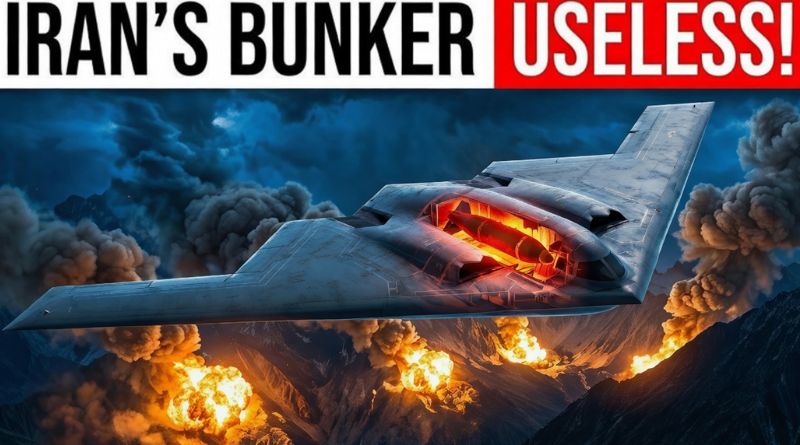
This reality came into sharp focus during a dramatic U.S. military mission known as Operation Midnight Hammer. In a carefully coordinated strike, seven B-2 Spirit stealth bombers departed from Whiteman Air Force Base in Missouri and embarked on an eighteen-hour flight toward Iranian airspace. Their objective was clear: deploy fourteen GBU-57 Massive Ordnance Penetrator bombs against the heavily fortified Fordow facility.
The operation illustrated how advances in military technology and strategic planning have transformed the way nations approach high-value targets.
The Origins of the Fordow Facility
Fordow’s construction was deeply influenced by past vulnerabilities in Iran’s nuclear program. Earlier cyberattacks—most notably the Stuxnet virus—demonstrated that even sophisticated systems could be compromised. In response, Iran pursued a strategy focused on physical protection.
The result was a facility carved nearly 300 feet into a mountain. By placing the enrichment plant deep underground, engineers aimed to shield it from aerial bombardment and surveillance. The project also carried symbolic weight, representing Iran’s determination to safeguard its nuclear infrastructure despite international pressure.
Fordow became more than a technical installation; it was a statement of resilience and strategic independence.
The GBU-57: Designed for Hardened Targets
At the heart of Operation Midnight Hammer was the GBU-57 Massive Ordnance Penetrator, often referred to as a “bunker-buster.” Developed over more than a decade, the weapon was engineered specifically to defeat deeply buried structures like Fordow.
Unlike conventional bombs, the GBU-57 is designed to penetrate layers of rock, soil, and reinforced concrete before detonating. One of its most advanced features is the Large Penetrator Smart Fuze. This system allows the bomb to analyze conditions during its descent and determine the most effective moment to explode after penetrating the target.
By delaying detonation until the weapon reaches the optimal depth, the bomb maximizes destructive force against underground structures.
The Role of the B-2 Spirit
Delivering such a weapon requires an aircraft capable of reaching heavily defended airspace without detection. The B-2 Spirit stealth bomber fulfills that role.
With its distinctive flying-wing design and advanced radar-evading technology, the B-2 can penetrate sophisticated air defense networks. It remains the only aircraft capable of carrying and deploying the GBU-57.
This combination of stealth capability and heavy payload made the B-2 the centerpiece of the mission.
A Strategy of Deception
To increase the chances of success, U.S. planners implemented a deception strategy alongside the main strike. While the actual group of bombers flew east toward Iran, additional aircraft were sent in another direction to create confusion and divert attention.
This maneuver complicated the task of tracking the incoming strike and reduced the likelihood that Iranian defenses would identify the real threat in time.
As the B-2 bombers reached the Fordow area, they reportedly flew over the facility for roughly twenty-five minutes. During that time, no defensive fire was launched at the aircraft, highlighting the effectiveness of stealth technology and surprise.
Uncertain Results
In the aftermath of the operation, analysts debated the true extent of the damage. Some assessments suggested the strike significantly disrupted Iran’s nuclear capabilities, while others argued that the underground structure may have limited the overall impact.
Reports from different intelligence agencies offered conflicting interpretations, underscoring how difficult it can be to evaluate the results of strikes against deeply buried facilities.
Broader Implications
Beyond the immediate military effects, Operation Midnight Hammer reflects broader shifts in modern warfare. Precision weapons, stealth aircraft, cyber operations, and deception tactics now play central roles in how conflicts unfold.
The strike also highlights the ongoing strategic competition in the Middle East, where technological innovation and geopolitical rivalry intersect.
Whether the operation ultimately strengthened global security or intensified regional tensions remains a matter of debate. What is clear, however, is that it demonstrated how far nations are willing to go to protect—or challenge—critical strategic assets.
As military technology continues to evolve, the lessons from operations like this will likely influence defense planning and international relations for years to come.