In the opening days of Operation Epic Fury, a large-scale military campaign involving the United States and allied forces in the Middle East, tragedy struck American troops serving overseas.
Six U.S. service members lost their lives in a single attack — a sobering reminder of the human cost of military operations and the risks faced by those deployed far from home. Their deaths mark the first confirmed American combat fatalities since the launch of the operation, leaving families, fellow Soldiers, and communities across the United States mourning their loss.
The incident occurred on March 3, 2026, when the U.S. Department of Defense confirmed that an attack at the Port of Shuaiba in Kuwait had killed at least six American troops assigned to a logistics unit supporting operations in the region.
The Attack at Port Shuaiba
According to military officials, the service members were killed when an unmanned aircraft system — believed to be a drone — struck a U.S. operational area within the Port of Shuaiba.
The strike targeted a command and coordination space where personnel were conducting sustainment and logistical planning activities. Although the port is not traditionally viewed as a front-line combat position, it plays a vital role in supporting U.S. and coalition operations across the Middle East.
For years, Port Shuaiba has served as a key logistics hub, coordinating the movement of supplies, equipment, and personnel for military missions across the region. The attack demonstrated how modern warfare increasingly blurs the line between combat zones and support areas, as long-range weapons and drone technology allow adversaries to strike far beyond traditional battlefields.
The incident occurred during the early phase of Operation Epic Fury, which began in late February following joint military action by the United States and Israel against hostile forces in the region amid escalating tensions.
The Soldiers Who Lost Their Lives
All six of the fallen service members were assigned to the 103rd Sustainment Command (Expeditionary), an Army Reserve unit headquartered in Des Moines, Iowa. The unit specializes in logistics, supply coordination, and operational support — essential tasks that ensure deployed forces receive the equipment and resources needed to carry out missions.
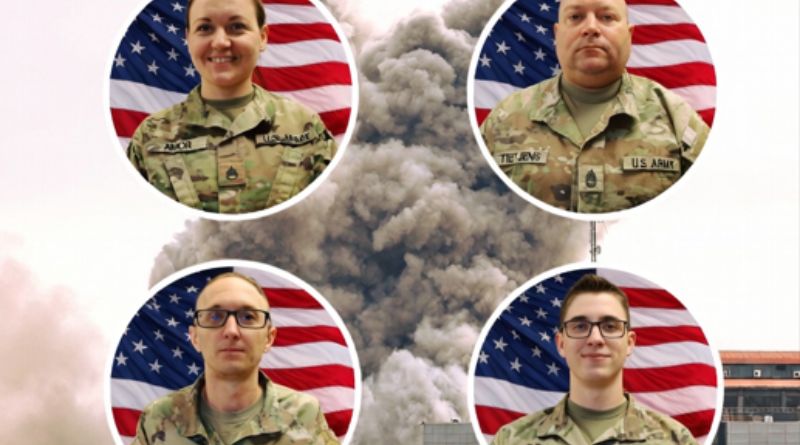
The Pentagon initially released the names of four of the Soldiers on March 3, while withholding the remaining two pending family notification.
Captain Cody A. Khork, 35, of Winter Haven, Florida, served with distinction in the Army Reserve after enlisting in 2009. Over the course of his career, he worked as a Military Police officer and deployed to several locations, including Saudi Arabia, Guantánamo Bay, and Poland. Known among colleagues for his leadership and dedication, Khork received numerous awards, including the Meritorious Service Medal and the Military Outstanding Volunteer Service Medal.
Sergeant First Class Nicole M. Amor, 39, of White Bear Lake, Minnesota, devoted much of her adult life to military service. She began her career in the National Guard in 2005 before transferring to the Army Reserve, where she served as a logistics specialist. Amor deployed multiple times, including tours in Kuwait and Iraq, and was respected within her unit as a dependable leader and mentor.
Sergeant First Class Noah L. Tietjens, 42, from Bellevue, Nebraska, was recognized for his technical knowledge and steady leadership. As a wheeled vehicle mechanic, he played a critical role in maintaining military vehicles and equipment used in operations across the region. Tietjens completed several deployments and earned commendations for his dedication to keeping units mission-ready.
Sergeant Declan J. Coady, 20, of West Des Moines, Iowa, was the youngest of the four initially identified service members. He enlisted in the Army Reserve in 2023 as an Information Technology specialist and had aspirations of pursuing a career in cybersecurity. Following his death, Coady was posthumously promoted from Specialist to Sergeant, honoring his service and potential.
On March 5, the Pentagon confirmed the identities of the remaining two Soldiers killed in the strike.
They were Chief Warrant Officer 3 Robert M. Marzan, 54, of Sacramento, California, and Major Jeffrey R. O’Brien, 45, of Indianola, Iowa. Both served in key operational support roles within the 103rd Sustainment Command, contributing to the complex logistics systems that support U.S. forces deployed overseas.
Military Leaders Honor Their Sacrifice
Following the announcement of the deaths, senior military officials issued statements paying tribute to the fallen service members and acknowledging the sacrifice made by them and their families.
Lieutenant General Robert Harter, Chief of Army Reserve and Commanding General of the U.S. Army Reserve, emphasized the courage and dedication of the troops.
“We honor our fallen heroes, who served fearlessly and selflessly in defense of our nation,” Harter said in a statement. “Their sacrifice, and the sacrifices of their families, will never be forgotten.”
Other commanders echoed similar sentiments. Major General Todd Erskine described the service members as “the heart of America,” noting that the nation’s security depends on individuals willing to serve in dangerous conditions far from home.
Brigadier General Clint A. Barnes also praised the Soldiers’ professionalism and character, calling them “ambassadors for freedom” whose actions represented the values of the United States military.
Communities Across the Country Mourn
News of the attack quickly spread across the hometowns of the fallen troops, prompting an outpouring of grief and remembrance.
In Iowa — home to several members of the 103rd Sustainment Command — local leaders and residents expressed condolences to the families affected. Community members, veterans groups, and public officials have shared tributes honoring the lives of the Soldiers who were killed.
Among those who spoke publicly was Iowa gubernatorial candidate Rob Sand, who urged residents to remember the sacrifices made by the service members and to keep their families in their thoughts and prayers. He specifically highlighted the life of Sgt. Declan Coady, whose youth and promise made the loss especially difficult for many in the community.
Across the country, national news outlets and military publications have published tributes recounting the lives and careers of the six service members — honoring their commitment to duty, their dedication to their fellow Soldiers, and the communities that shaped them.
Their deaths serve as a stark reminder that behind every military operation are the men and women who carry it out — and the families and communities who share in both their service and their sacrifice.