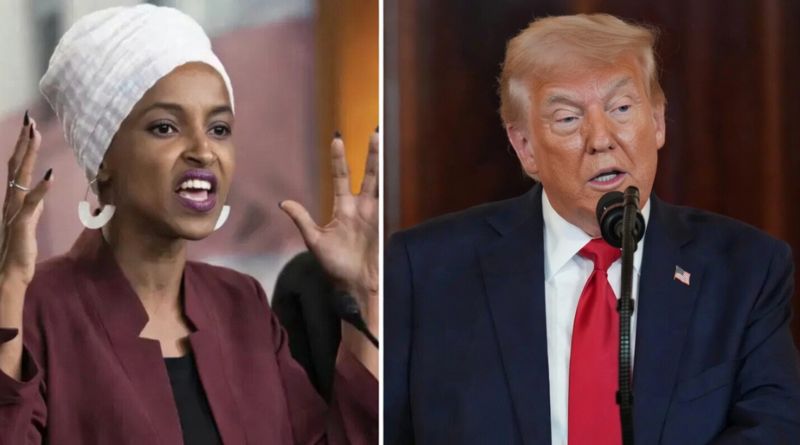
Rep. Ilhan Omar, a Democrat from Minnesota, is drawing sharp criticism after posting on social media that the United States deliberately targets Muslim-majority countries during the Islamic holy month of Ramadan. Her comments came as tensions escalated ahead of a U.S. military strike against Iran, sparking a heated debate about political rhetoric during times of international conflict.
In a post on X, Omar wrote that the United States attacked Iraq during Ramadan and suggested the same pattern was repeating. “Iraq was attacked by the U.S. during Ramadan and it is sickening to know that the U.S. is again going to attack Iran during Ramadan,” she wrote. Omar continued by claiming that the United States “apparently loves to strike Muslim countries during Ramadan,” adding that she believes such actions are driven not by violations of international law but by the religion practiced in those countries.
Her comments quickly prompted backlash from critics who argued that such claims are misleading and potentially harmful while American forces face a volatile military standoff in the Middle East. Some critics said that rhetoric suggesting the United States wages war against Muslims risks providing propaganda material for adversaries, including the Iranian government.
Under the U.S. Constitution, however, treason is defined very narrowly. It requires either waging war against the United States or giving aid and comfort to its enemies. Legal experts have long emphasized that controversial speech alone does not meet this threshold. To qualify as treason, there must be clear intent and tangible actions that assist an enemy power.
Even so, some opponents argue that statements like Omar’s can reinforce narratives promoted by hostile regimes. They contend that portraying U.S. military action as religiously motivated may undermine American diplomatic efforts and embolden adversaries at a particularly sensitive moment.
Supporters of Omar strongly reject those criticisms. They point out that political speech — including sharp criticism of U.S. foreign policy — is protected by the First Amendment. Historically, courts have set an extremely high bar for proving treason, requiring concrete acts and clear evidence of alignment with enemy governments, not simply controversial opinions or political commentary.
The dispute reflects a broader tension in American politics between protecting robust free expression and concerns about rhetoric that critics believe may inflame international tensions.
Omar’s claim also drew scrutiny on X itself. The platform attached a community note to her post after users pointed out factual issues with the assertion that the United States times military operations during Ramadan. Several commenters noted that the U.S.-led invasion of Iraq under President George W. Bush began on March 20, 2003, months before Ramadan that year. Others pointed to the start of Operation Desert Storm on January 17, 1991, under President George H.W. Bush — roughly two months before Ramadan began — as further evidence contradicting the claim.
Among those criticizing Omar was Iraqi-American political commentator Dalia al-Aqidi, who is running against her for her congressional seat. Al-Aqidi argued that claims suggesting America intentionally targets Muslims during Ramadan are misleading and divisive.
Meanwhile, U.S. officials have continued to emphasize the strategic objectives behind the current military operation involving Iran. Defense Secretary Pete Hegseth said Monday that the mission is tightly focused on eliminating Iran’s missile capabilities and preventing it from acquiring nuclear weapons.
Speaking alongside Chairman of the Joint Chiefs of Staff Gen. Dan Caine, Hegseth said the operation aims to destroy Iranian missile systems, missile production facilities, naval assets, and other military infrastructure. He declined to provide a timeline for the campaign but insisted it would not become a prolonged conflict.
“This is not Iraq. This is not endless,” Hegseth said, stressing that the goal is a decisive mission to neutralize the missile threat and ensure Iran cannot develop nuclear weapons.
Officials also confirmed that no U.S. ground troops are currently deployed inside Iran, though Hegseth declined to speculate about potential future military options.
The conflict has already taken a human toll. At least 11 people have been reported killed in Israel, while the Iranian Red Crescent says more than 500 people have died in Iran. Military leaders say it will take time to fully assess the damage from ongoing strikes and determine the next steps in the operation.
As the situation continues to unfold, the controversy surrounding Omar’s comments highlights how political messaging at home can quickly intersect with geopolitical tensions abroad.