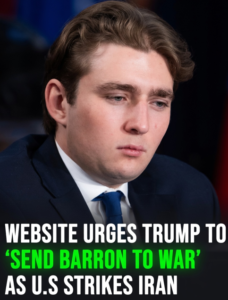
In early March 2026, an unexpected trend swept across social media platforms in the United States and beyond. The name Barron Trump, the youngest son of Donald Trump, began appearing in thousands of posts, memes, and online conversations connected to the growing tensions between the United States and Iran.
The sudden surge of attention did not stem from any public statement by Barron Trump, nor from involvement in politics or the military. Instead, the attention was fueled by a piece of political satire that spread rapidly across the internet and sparked a wave of commentary, humor, and debate.
At the center of the viral moment was a parody website called DraftBarronTrump.com, a satirical project designed to provoke discussion about war, political leadership, and who ultimately bears the consequences of military decisions.
A Satirical Website Goes Viral
The website first appeared on February 28, 2026, the same day reports circulated that U.S. and Israeli forces had carried out coordinated strikes against targets in Iran. Within hours of the news breaking, DraftBarronTrump.com began circulating across social media platforms including X (formerly Twitter), Facebook, Instagram, and Reddit.
The site was created by Toby Morton, a comedy writer known for his past work on programs such as South Park and MADtv. Morton has also been involved in several online satire projects that use humor to comment on political events and public figures.
Like much of Morton’s work, the site relies on exaggerated patriotic language and intentionally over-the-top messaging to highlight the absurdity of its premise. The central idea is a mock “petition” suggesting that Barron Trump should be drafted to serve in the military following the launch of military operations abroad.
While the concept may sound provocative at first glance, the website’s tone makes its satirical intent clear. The language mimics familiar political rhetoric but pushes it to comedic extremes.
The Humor Behind the Message
Visitors to DraftBarronTrump.com encounter a homepage styled to resemble a patriotic call to action. However, the wording quickly signals that the page is not meant to be taken literally.
Among the slogans featured on the site are lines such as:
-
“America is strong because its leaders are strong.”
-
“Naturally, his son Barron is ready to defend the country his father commands.”
-
“Service is honor. Strength is inherited. Dog Bless Barron.”
The exaggerated tone mirrors the kind of patriotic messaging often used in political campaigns or public speeches but pushes it into parody.
The site also includes fabricated testimonials supposedly from members of the Trump family. These humorous “quotes” exaggerate admiration or patriotic enthusiasm, reinforcing the idea that the entire project is meant as satire rather than a real political effort.
By framing the idea of drafting a president’s teenage son in such dramatic language, the site aims to spark reflection about political rhetoric surrounding war and sacrifice.
The Rise of #SendBarron
Soon after the website appeared online, a related hashtag — #SendBarron — began spreading rapidly across social media platforms.
Within hours, users were sharing links to the site, screenshots of its slogans, and memes built around the concept. The hashtag quickly gained traction on X, Threads, Reddit, and other platforms, becoming a focal point for online discussion.
Many users embraced the satirical tone and created humorous images depicting Barron Trump in fictional military scenarios or mock recruitment posters.
Other posts used the hashtag more seriously as a way to express frustration about broader political issues connected to the conflict with Iran.
While the tone varied widely, several recurring themes appeared in the conversations:
Criticism of political privilege:
Some users argued that political leaders who support military action rarely see their own families exposed to the risks faced by soldiers.
Discussion of the military draft:
Although the United States does not currently operate under an active military draft, some posts jokingly referenced selective service and debated whether the children of political leaders should be required to serve.
Humor about Barron Trump’s height:
Barron Trump, who has been widely reported to stand around 6 feet 9 inches tall, became the subject of additional jokes. Some commenters noted that extreme height can sometimes complicate military equipment fitting, adding another layer of humor to the already fictional premise.
Despite the intensity of online conversation, it is important to emphasize that the trend has remained almost entirely within the realm of memes and commentary.
Why the Satire Struck a Nerve
The viral spread of DraftBarronTrump.com came at a moment when global attention was focused on the escalating conflict between the United States, Israel, and Iran.
Reports of coordinated strikes against Iranian targets sparked widespread political debate in the United States and abroad. Questions about the justification, scale, and long-term consequences of the military action quickly became topics of discussion in news outlets and online forums.
In that environment, the satirical concept behind DraftBarronTrump.com resonated with many internet users. Humor often spreads most rapidly when it taps into deeper public anxieties or frustrations, and the parody provided a way for people to comment on serious issues through comedy.
For some participants, sharing the hashtag or memes became a way to criticize political leadership or highlight perceived inequalities in who bears the costs of war.
For others, the trend was simply an opportunity for internet humor during a tense geopolitical moment.
Separating Fact from Satire
Because the trend spread so quickly, some observers initially wondered whether the website represented a real political campaign or advocacy effort. In reality, several facts clarify the situation.
First, DraftBarronTrump.com is entirely satirical. It is not affiliated with any political organization, government office, or official policy proposal.
Second, Barron Trump is not being drafted or considered for military service. There has been no statement from the U.S. government or the military suggesting such a possibility.
Third, the hashtag #SendBarron is largely meme-driven. While some users employ it to express political criticism, the vast majority of posts fall into the categories of satire, humor, or commentary.
Understanding the satirical nature of the trend helps prevent misinformation from spreading online.
The Role of Political Satire
Political satire has long played a role in American public life. From newspaper cartoons to television comedy shows and internet memes, humor has often been used as a tool to challenge authority, question policy decisions, and engage the public in political debate.
Projects like DraftBarronTrump.com continue that tradition in the digital era.
By presenting an obviously unrealistic idea — that a president’s teenage son should be drafted into combat — the satire encourages people to think about larger issues. These include questions about leadership accountability, the social dynamics of military service, and the human consequences of war.
Whether people interpret the joke as clever criticism, controversial humor, or simply another viral meme, the trend demonstrates how quickly satire can shape online conversation.
A Viral Moment of Internet Commentary
In the end, the sudden prominence of Barron Trump in online discussions during early March 2026 had little to do with the teenager himself.
Instead, it reflected the power of internet satire to capture public attention and channel broader political sentiment.
What began as a parody website created by a comedy writer rapidly evolved into a viral social media moment, blending humor, political commentary, and meme culture into one of the more unusual online trends tied to the unfolding geopolitical tensions of the year.
While the hashtag may fade as quickly as it appeared, the episode serves as another reminder of how satire continues to influence modern political conversation in the digital age.