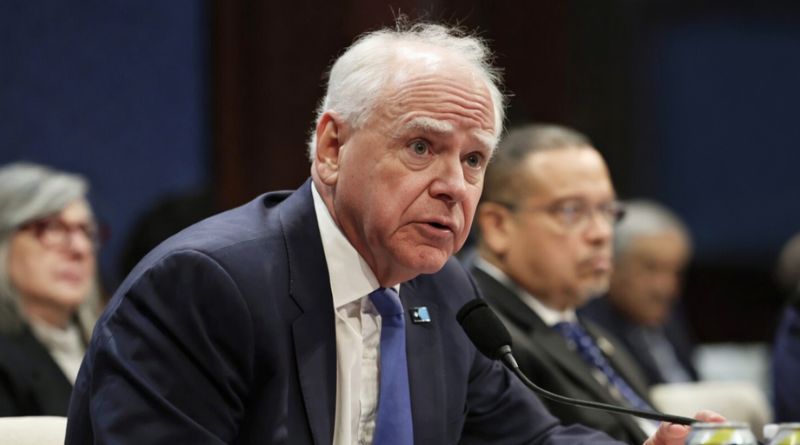
House Oversight Committee Chairman James Comer plans to sharply criticize Minnesota Gov. Tim Walz during a congressional hearing focused on alleged fraud involving federally funded welfare programs in the state. Comer is expected to argue that Walz failed to act on early warnings about potential abuse and that whistleblowers who raised concerns were ignored or punished.
In prepared remarks released ahead of the hearing, Comer contends that Walz and Minnesota Attorney General Keith Ellison were aware of serious risks within several state-administered federal programs long before publicly acknowledging the scale of the problem.
“While Governor Walz hesitated, taxpayers lost billions,” Comer is expected to say. “Attorney General Ellison has also claimed his office aggressively pursued fraudsters, but those claims do not hold up when compared to the documented record.”
The Republican-led committee says it has interviewed more than 30 whistleblowers as part of its investigation. According to Comer’s remarks, these individuals include current state employees and Democrats who claim their warnings were dismissed or met with retaliation.
“We have spoken with over thirty whistleblowers, many of them current employees and Democrats, who say they were ignored, retaliated against, and even surveilled for raising concerns,” Comer plans to say. “Instead of protecting the whistleblowers, the Walz administration protected the system that enabled fraud.”
The hearing follows the publication of a 53-page report from the committee detailing what investigators describe as early signs of fraud in several programs administered by Minnesota. The report alleges that Walz and Ellison were alerted to irregularities in the state’s Child Care Assistance Program and certain Medicaid programs as early as the spring of 2019. It also claims state officials were warned about potential fraud in food aid programs run through the Minnesota Department of Education beginning in April 2020.
According to the report, internal records and testimony suggest state leaders were aware of vulnerabilities long before the public learned about them.
“While the Committee continues to review documents and meet with whistleblowers, it is evident that Governor Walz and Attorney General Ellison knew about the fraud in federal programs administered by the State of Minnesota much earlier than they told the American people,” the report states.
The investigation follows criminal charges filed by federal prosecutors in connection with Feeding Our Future, a Minnesota nonprofit accused of orchestrating a massive fraud scheme involving the Federal Child Nutrition Program. Prosecutors allege that more than $240 million intended to feed children was stolen through the operation.
Authorities have since expanded their inquiries into other state-run programs, including Medicaid and childcare assistance systems, raising broader questions about oversight and accountability.
Comer is expected to describe the situation as one of the most significant oversight failures his committee has investigated.
“Billions of taxpayer dollars were stolen from social service programs while warnings piled up, whistleblowers spoke out, and state officials chose delay and denial over action,” his prepared remarks state. Comer also cites federal estimates suggesting that as much as $9 billion could have been stolen from fourteen Medicaid programs administered in Minnesota.
Republicans on the committee argue the problem reflects systemic failures rather than isolated incidents.
“What we’ve uncovered in Minnesota is not a paperwork error or a few bad actors slipping through the cracks,” Comer intends to say. “It represents a sustained failure of leadership.”
The committee’s report also suggests that state officials hesitated to aggressively pursue fraud allegations because of concerns about political fallout involving Minneapolis’ influential Somali community, an assertion that is likely to provoke strong pushback from state leaders.
Walz and Ellison have consistently rejected accusations that they knowingly allowed fraud to occur. Both have accused House Republicans of politicizing ongoing investigations. Walz has also criticized the Trump administration’s previous decision to temporarily halt certain Medicaid reimbursements to Minnesota, describing it as politically motivated.
The issue has already produced tense exchanges on Capitol Hill. During earlier questioning, Rep. Jim Jordan pressed Walz about the decision to resume payments to organizations connected to Feeding Our Future following a court dispute.
As federal and state investigations continue, the hearing highlights the growing political battle between House Republicans and Minnesota’s Democratic leadership over responsibility for one of the largest alleged fraud schemes involving federal social programs in recent years.