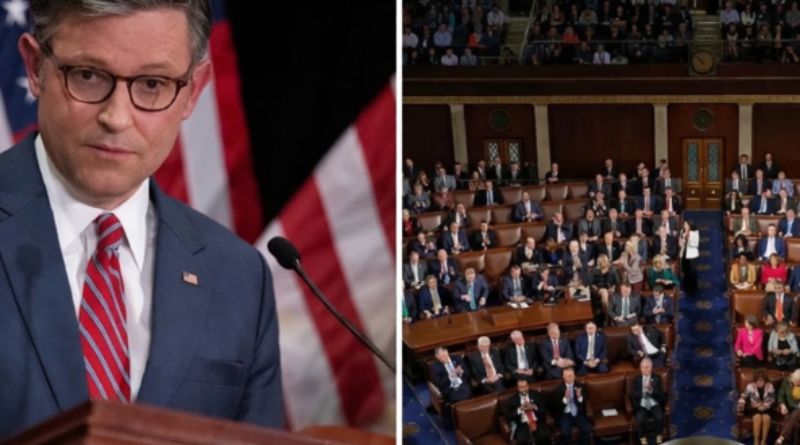

The Republican-controlled House of Representatives has passed new legislation designed to prevent future presidential administrations from banning oil and gas drilling without approval from Congress. The measure marks another legislative victory aligned with the energy priorities of President Donald Trump and his administration.
The bill, titled the “Protecting American Energy Production Act,” passed the House by a vote of 226 to 188. The legislation specifically prohibits a president from declaring a nationwide moratorium on hydraulic fracturing—commonly known as fracking—unless Congress first authorizes such a ban. Supporters of the bill say it ensures that major decisions affecting domestic energy production cannot be made unilaterally by the executive branch.
Voting on the measure largely followed party lines. Republican lawmakers unanimously supported the bill, while 118 Democrats voted against it. The legislation now moves forward as part of a broader Republican effort to promote expanded domestic energy development and limit regulatory actions that could restrict the oil and gas industry.
The bill comes in response to policies enacted near the end of former President Joe Biden’s term. Shortly before leaving office, Biden implemented several environmental measures affecting energy production, including a ban on future oil and gas drilling across approximately 625 million acres of coastal and offshore waters. Republicans have argued that those actions threatened American energy independence and placed unnecessary restrictions on a major domestic industry.
Representative August Pfluger of Texas, who introduced the legislation, said the bill was motivated by concerns that the Biden administration or future administrations could attempt to restrict fracking nationwide. Hydraulic fracturing has played a significant role in expanding U.S. oil and natural gas production over the past two decades.
In a statement following the bill’s passage, Pfluger criticized the previous administration’s energy policies and said the legislation was intended to reverse what he described as federal overreach.
“When President Biden took office, his administration took a ‘whole of government’ approach to wage war on American energy production,” Pfluger said. He argued that the new legislation represents an important step toward protecting the industry from federal restrictions and preserving energy jobs.
President Trump has repeatedly emphasized expanding U.S. energy production as a central component of his economic strategy. During his campaign and since returning to office, he has promoted the slogan “drill, baby, drill,” signaling his support for increased oil and gas development and reduced regulatory barriers for energy producers.
The administration has also begun reviewing policies adopted during the Biden years. Interior Secretary Doug Burgum recently initiated internal reviews of agency regulations that officials say may hinder energy development. The reviews are intended to identify policies that could be removed or modified, including climate-related regulations and limits on oil and gas leasing.
At the same time, political analysts note that energy policy remains closely tied to broader economic debates between the two major parties.
A recent poll highlighted on CNN suggested that Republicans currently hold an advantage over Democrats on economic issues in the eyes of many voters. The findings surprised CNN data analyst Harry Enten, who noted that the results come after months of political messaging from Democrats criticizing Trump’s economic policies, including tariffs and trade measures.
According to the poll, Republicans hold an eight-point advantage when voters are asked which party is closest to their economic views. Enten pointed out that a similar margin existed in late 2023, indicating that the gap has remained relatively stable.
Enten also referenced polling conducted by Reuters and Ipsos that asked voters which party has the better economic plan. In May 2024, Republicans held a nine-point advantage on that question. By May 2025, the margin had widened to a 12-point lead.
The persistence of that advantage, Enten said, is notable given ongoing economic debates, fluctuations in the stock market, and criticism of tariffs from some economists and voters.
He suggested the numbers reflect a broader challenge for Democrats in convincing voters that their economic policies are stronger than those of Republicans.
Despite fluctuations in approval ratings for President Trump, analysts say the Republican Party’s perceived strength on economic issues—particularly among middle-class voters—continues to shape the political landscape heading into future legislative and electoral battles.