The Ghost Motion: How the Retroactive Erasure of Justice is Redefining the Rule of Law
The hallowed halls of the Department of Justice have long been seen as the iron fortress of American accountability, a place where facts are stubborn and the law is supposed to be blind. However, in a startling turn of events in early 2026, that fortress appears to have developed a backdoor, and the tool of choice isn’t a gavel—it’s an eraser. The legal world was rocked this week by a motion that few saw coming and even fewer can justify under traditional statutes: a formal attempt to not only overturn but completely “ghost” the criminal conviction of Steve Bannon. As the ink dries on a document that seeks to pretend a four-month federal prison sentence never occurred, the nation is left wondering if the scales of justice are being recalibrated to favor political loyalty over the letter of the law.

This move is not a standard appeal or a request for a new trial based on emerging evidence; it is an act of legal alchemy. By moving to dismiss the conviction “with prejudice” after the sentence has already been served, the office is attempting to perform a total “wipeout” of Bannon’s history with the federal penal system.
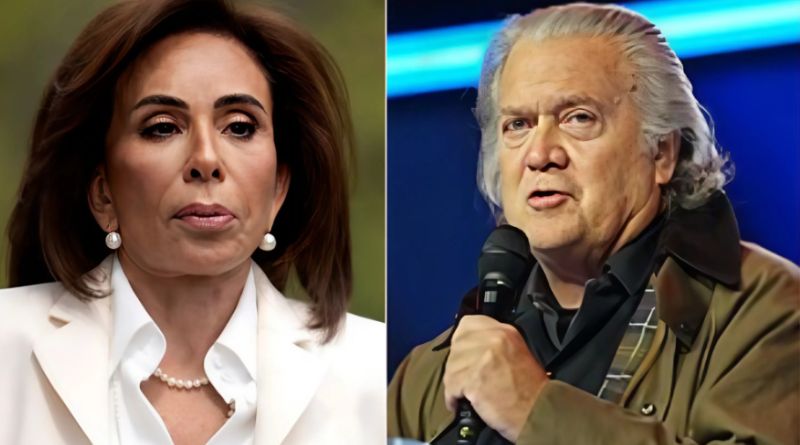
Perhaps the most chilling aspect of this legal maneuver is the complete absence of support from career prosecutors, leaving Pirro as a lone signatory on a document that breaks decades of Department of Justice tradition.
Typically, a motion of this magnitude—one that essentially rebukes a prior successful prosecution by the same office—would be signed by a phalanx of seasoned, non-partisan attorneys.
Instead, the document stands as a “solo act,” a stark visual representation of a fractured DOJ.
The deafening silence from the veteran lawyers within the U. S.
Attorney’s office speaks volumes; it suggests a deep-seated internal resistance to a move that many see as a violation of the “interests of justice.”
When career professionals refuse to put their names on a filing, it sends a clear signal that the motion may be driven more by a “loyalty test” than by a rigorous application of legal principles.

By attempting to erase a conviction for contempt of Congress, the U. S.
Attorney is effectively signaling that the legislative branch’s subpoena power is now a secondary consideration to executive whim.
The conviction of Steve Bannon was originally seen as a victory for the concept of Congressional oversight—a reminder that no citizen, regardless of their proximity to power, is above a lawful summons.
To dismantle that conviction now is to pull the teeth out of Congress’s ability to investigate the executive branch or any future national crises.
If a subpoena can be defied with the knowledge that a future political appointee will simply “delete” the consequences, then the subpoena itself becomes a mere suggestion.
This erosion of the “power of the purse and the person” shifts the balance of the American government toward an imperial executive where accountability is strictly optional.
This “Ghost Motion” introduces a dangerous new reality where accountability for defying the law is treated as an optional extra rather than a non-negotiable requirement of citizenship.
For the average American, the law is a rigid frame; for the politically connected in 2026, it is appearing more like a flexible net.
The message being broadcast from the highest levels of D. C.
law enforcement is that the consequences of one’s actions depend entirely on the alignment of their politics with the current administration.
If a criminal record can be scrubbed as a reward for political steadfastness, the deterrent effect of the law vanishes.
This creates a two-tiered system of justice: one for those who must follow the rules, and another for those who are close enough to the “eraser” to have their mistakes vanished from the books.

The perception of “loyalty laundering” at the highest levels of the Department of Justice threatens to shatter public trust in the impartiality of the American legal system.
When the public sees a U. S. Attorney standing alone to protect a political ally, the optics are devastating.
It suggests that the DOJ has transitioned from a neutral arbiter of truth into a specialized law firm for the powerful.
This “laundering” of a criminal conviction into a clean record serves no clear public interest; rather, it serves to protect the narrative of a specific political movement.
As trust in institutions continues to hit historic lows, the sight of the law being used as a shield for “friends of the office” provides further fuel for the fire of public cynicism, making it harder for citizens to believe that “equal justice under law” is anything more than a slogan on a building.
To ignore the specific context of Bannon’s conviction is to ignore the gravity of the January 6th investigation and the fundamental need for truth in the aftermath of a national crisis.
Bannon’s refusal to testify was not a minor technicality; it was a refusal to participate in the democratic process of uncovering the facts behind an attack on the U.
S. Capitol. By erasing the conviction, the current leadership is implicitly suggesting that the investigation itself was illegitimate.
This moves the needle beyond mere “prosecutorial discretion” and into the realm of historical revisionism.
It treats a turning point in American history as a “misunderstanding” that can be smoothed over with a well-placed motion, disregarding the millions of Americans who watched those events unfold and expected a full, transparent accounting of the truth.

If the law becomes a tool for political protection rather than a shield for the public interest, the very definition of “equal justice under law” will be rendered obsolete.
The “Ghost Motion” is a symptom of a much larger malady: the weaponization of the “dismissal” as a reward for partisan service.
If this precedent holds, future administrations of all stripes will feel emboldened to use the U. S.
Attorney’s office as a “cleanup crew” for their predecessors or allies.
The stability of a republic relies on the predictable application of the law; once the law becomes unpredictable and subject to the winds of the latest election, the foundation of the state begins to crumble.
We are witnessing a moment where the line between a justice system and a political protection racket has never been thinner.
Ultimately, the “Ghost Motion” serves as a powerful reminder that the rule of law is not a self-sustaining force, but one that must be protected by the courage of those who wield it.
As Jeanine Pirro stands alone on this filing, the shadow of Bannon’s erased conviction falls long over the future of the D.
C. courts.
Justice is meant to be a permanent record of a society’s values, a ledger that holds the powerful to account for the sake of the powerless.
When that ledger is treated like a dry-erase board, the concept of a “permanent” justice disappears.
Whether this is a “necessary correction” or the final act in the tragedy of equal justice remains to be seen, but one thing is certain: the eraser is now as powerful as the gavel.